


Over half of American small businesses struggle to afford custom websites, putting digital growth out of reach for many owners. This challenge matters because a strong online presence often makes the difference between success and obscurity in United States retail and local services. Discover how no code platforms are reshaping website creation, letting entrepreneurs launch professional sites quickly without high costs or technical hurdles.
Table of Contents
- No Code Websites Defined and Debunked
- Comparing No Code and Traditional Web Development
- Key Features Driving No Code Adoption
- Real-World Use Cases for Small Business
- Cost, Risks, and Common Pitfalls
Key Takeaways
| Point | Details |
|---|---|
| Accessibility of No Code Platforms | No code platforms enable non-technical users to build professional websites quickly and affordably, democratizing web development. |
| Consideration of Limitations | While no code platforms offer ease of use, businesses should assess potential scalability and customization challenges before implementation. |
| Importance of Research | Entrepreneurs must thoroughly research and test various no code platforms to find the best fit for their specific needs and industry requirements. |
| Hybrid Strategy Recommendation | A hybrid approach that begins with a no code solution and evolves to custom development can effectively address growing business demands. |
No Code Websites Defined and Debunked
No code websites represent a groundbreaking digital solution that empowers small business owners to create sophisticated online presences without technical programming skills. Visual development platforms enable entrepreneurs to construct websites through intuitive drag-and-drop interfaces, transforming complex web development into an accessible, user-friendly experience.
Traditionally, building a website required extensive coding knowledge or expensive professional services. No code platforms completely disrupt this model by providing pre-built components, templates, and automated design systems that allow non-technical users to rapidly generate professional websites. Research from academic studies demonstrates these platforms are not just simple tools, but sophisticated systems capable of creating scalable, secure digital experiences.
The core features of no code websites typically include:
- Drag-and-drop page builders
- Pre-designed responsive templates
- Integrated design systems
- Automated mobile optimization
- Built-in SEO tools
- Lead capture functionality
- Quick deployment capabilities
Contrary to common misconceptions, no code platforms are not limited to basic websites. They can support complex business requirements, offering advanced integrations, custom workflows, and professional design capabilities that rival traditionally coded sites. Small business owners can now compete digitally without massive upfront technology investments.
Pro Tip: Before selecting a no code platform, always test multiple templates and verify the platform supports your specific industry requirements.
Comparing No Code and Traditional Web Development
Web development approaches have evolved dramatically, with no code platforms challenging traditional coding methods by offering unique advantages for small businesses. Comparative research reveals significant differences in development strategies, highlighting strengths and limitations of each approach that can dramatically impact a business's digital strategy.
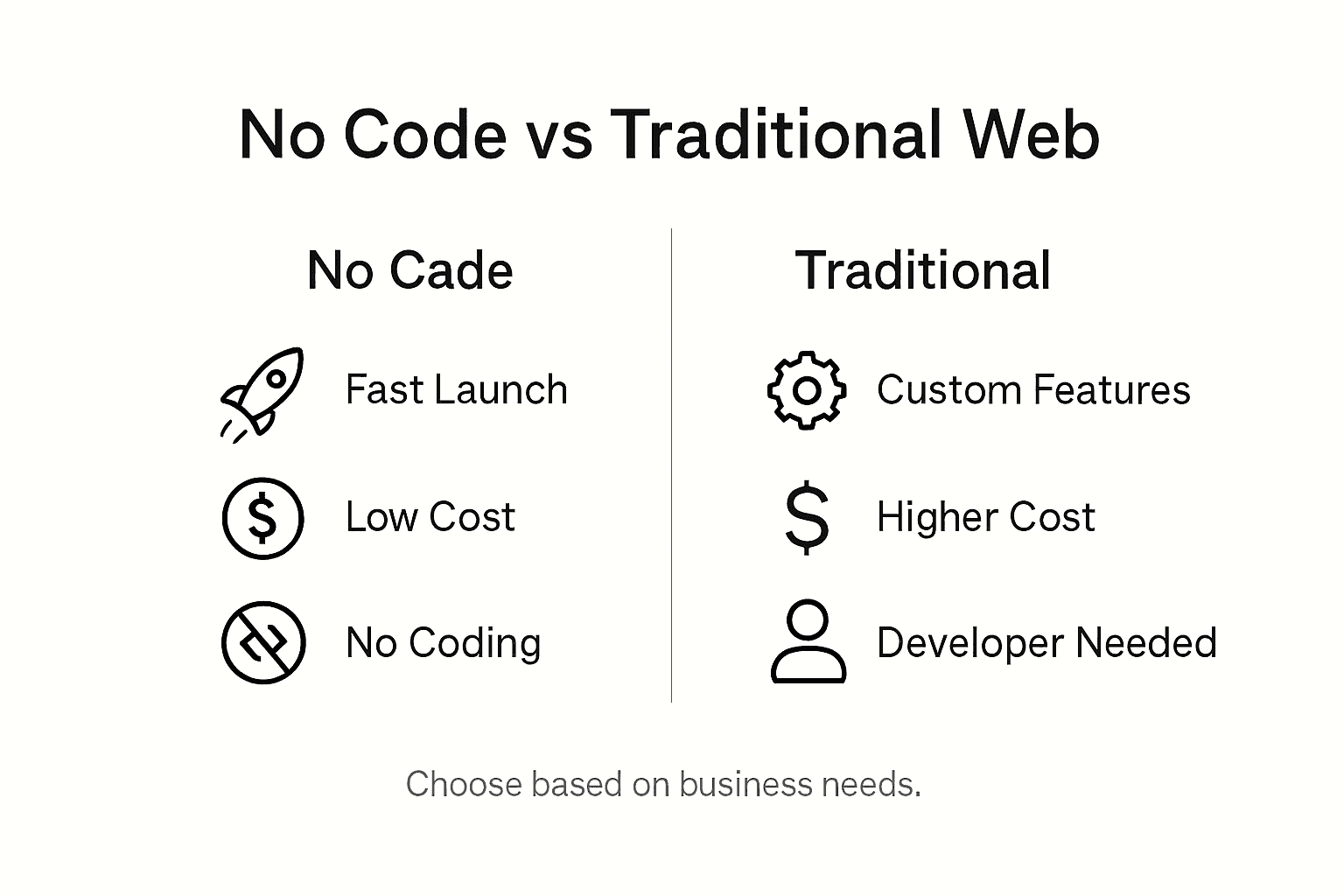
Traditional web development relies on hand-coded solutions using programming languages like JavaScript, HTML, and CSS, providing maximum flexibility and deep customization. In contrast, no code platforms offer drag-and-drop interfaces that enable non-technical users to create functional websites quickly. Detailed analyses demonstrate these approaches serve different business needs and are not necessarily competing technologies.
Key comparison points between no code and traditional web development include:
- Development Speed
- No Code: Minutes to hours
- Traditional: Weeks to months
- Cost
- No Code: Low upfront investment
- Traditional: Higher initial expenses
- Customization Level
- No Code: Limited but improving
- Traditional: Unlimited technical possibilities
- Technical Expertise Required
- No Code: Minimal
- Traditional: Extensive programming knowledge
While no code platforms democratize web development, they aren't universal solutions. Complex, highly specialized websites still require traditional coding expertise. Small businesses must evaluate their specific requirements, budget, and technical capabilities when choosing between these approaches.
Here is a concise comparison of how no code and traditional web development approaches align with common small business priorities:
| Business Priority | No Code Approach | Traditional Development |
|---|---|---|
| Time to Launch | Extremely fast, days or less | Slow, often weeks or months |
| Initial Investment | Low to moderate | High, may require contractors |
| Flexibility for Growth | Moderate, with some limits | High, as needed |
| Ongoing Maintenance | Easy, handled via platform | Complex, needs technical support |
Pro Tip: Consider a hybrid approach that starts with a no code platform and transitions to custom development as your business grows and requires more sophisticated digital solutions.
Key Features Driving No Code Adoption
No code platforms are transforming digital development by offering powerful features that make website creation accessible to non-technical entrepreneurs. Comprehensive platform evaluations highlight key technological capabilities that are revolutionizing how small businesses approach online presence and digital strategy.

Modern no code platforms provide an impressive array of sophisticated tools that go far beyond simple drag-and-drop interfaces. Detailed platform reviews reveal advanced features designed to empower business owners with robust digital solutions without requiring extensive technical expertise.
Critical features driving no code platform adoption include:
- Workflow Automation
- Automated task sequencing
- Integrated process management
- Seamless action triggers
- Rapid Deployment Tools
- One-click publishing
- Instant website generation
- Quick content updates
- Advanced Integration Capabilities
- API connectors
- Third-party tool synchronization
- Cross-platform data sharing
- User Experience Design
- Responsive mobile templates
- Customizable design elements
- Professional layout options
While no code platforms continue evolving, they represent a significant technological shift toward democratizing web development. Small business owners can now create professional digital experiences without extensive technical training or substantial financial investment.
Pro Tip: Select a no code platform that offers scalable features and allows future expansion as your business digital needs grow.
Real-World Use Cases for Small Business
No code platforms have become transformative tools for small businesses, enabling entrepreneurs to solve complex operational challenges without extensive technical expertise. Comprehensive research on practical applications reveals numerous scenarios where these platforms provide game-changing solutions across diverse business sectors.
Small businesses are leveraging no code platforms to streamline critical operational processes that traditionally required expensive custom software development. These platforms enable rapid solution creation for challenges ranging from customer relationship management to inventory tracking, allowing entrepreneurs to adapt quickly and efficiently.
Specific real-world use cases demonstrate the versatility of no code platforms:
- Retail Inventory Management
- Automatic stock tracking
- Real-time product updates
- Low-cost inventory monitoring
- Service Business Scheduling
- Online booking systems
- Automated client reminders
- Integrated payment processing
- Customer Relationship Management
- Contact database organization
- Lead tracking
- Communication workflow automation
- Event and Appointment Coordination
- Digital registration platforms
- Participant management
- Automated communication sequences
By eliminating traditional software development barriers, no code platforms empower small business owners to create sophisticated digital solutions tailored to their unique operational needs. These tools transform complex technological challenges into manageable, user-friendly systems that drive efficiency and growth.
Pro Tip: Start with one specific business process and gradually expand your no code platform capabilities as you become more comfortable with the technology.
Cost, Risks, and Common Pitfalls
No code platforms offer tremendous potential, but small business owners must approach them with strategic awareness. Systematic research reveals nuanced challenges that extend beyond surface-level promises, demanding careful evaluation of potential limitations and hidden expenses.
The financial landscape of no code platforms involves more than simple upfront licensing costs. Business owners must consider long-term implications, including potential vendor lock-in, integration complexities, and scalability constraints that could impact future growth. Understanding these dynamics helps entrepreneurs make informed decisions about technological investments.
Key risks and potential pitfalls include:
- Financial Considerations
- Recurring subscription fees
- Potential upgrade expenses
- Cost of additional feature integrations
- Technical Limitations
- Platform-specific customization restrictions
- Performance bottlenecks
- Limited advanced functionality
- Operational Risks
- Data migration challenges
- Third-party platform dependencies
- Potential security vulnerabilities
- Scalability Concerns
- Growth limitations
- Performance degradation
- Complex workflow restrictions
While no code platforms democratize technology access, they are not universal solutions. Small businesses must conduct thorough assessments, understanding both the capabilities and constraints of these platforms to ensure alignment with their specific operational requirements and long-term strategic objectives.
The following table summarizes potential risks of no code platforms and strategies to address them:
| Risk Area | Example Challenge | Recommended Mitigation |
|---|---|---|
| Financial | Hidden upgrade costs | Review fee structures regularly |
| Technical | Customization restrictions | Test platform before commitment |
| Operational | Data migration issues | Plan for export/import early |
| Scalability | Growth limitations | Choose platforms with expansion paths |
Pro Tip: Request comprehensive platform demos and conduct thorough testing before committing to any no code solution to uncover potential hidden limitations.
Unlock Small Business Success with No Code Websites Powered by Uncody
The article highlights how no code platforms solve the challenge of creating professional websites quickly without technical skills or hefty investments. If you are a small business owner facing tight budgets, limited time, and the need for a digital presence that drives real leads, Uncody offers the perfect solution. With AI-driven automation, customizable mobile-responsive templates, and industry-specific content, you can launch a high-converting website in minutes without coding headaches.
Experience how Uncody transforms complex website development into an easy, affordable process tailored specifically for your business needs. Features like integrated lead capture and local SEO enhancements help increase customer engagement from day one. Discover the full potential of no code for your growth by exploring Uncody's AI Website Builder and see why entrepreneurs across sectors are making their online presence work smarter, not harder.
Ready to take control of your digital strategy today?
Get started now at Uncody and build your professional small business website faster than ever before. Don't wait for technical complexity to slow your success—embrace no code simplicity and watch your business thrive.
Frequently Asked Questions
What are no code websites?
No code websites are digital platforms that allow users to create and manage websites without needing programming skills. They utilize visual development tools such as drag-and-drop builders and pre-designed templates.
How do no code platforms compare to traditional web development?
No code platforms offer faster development times, lower initial costs, and require minimal technical expertise compared to traditional web development, which often involves extensive coding and a higher investment.
What features should I look for in a no code website platform?
Important features include workflow automation, rapid deployment tools, advanced integration capabilities, user experience design, and built-in SEO tools to optimize your site's performance.
What are some common pitfalls of using no code platforms?
Common risks include potential hidden costs, technical limitations regarding customization, and scalability concerns that may arise as your business grows. It's essential to conduct thorough testing and evaluation before committing to a no code solution.